I hate needles.
This is an improvement over the era (childhood) when I was terrified of needles.
I could never imagine getting ears (or anything else) pierced, or skin tattooed. Voluntarily having a needle punched into your skin for something not related to medical needs? No, thank you.
Recently I had a flare-up of an old rotator cuff injury and my physiotherapist pulled out a set of acupuncture needles. The thought made me queasy, but I agreed to give it a go. I can get blood tests ordered by my doctor without making a huge scene, as long as I can close my eyes, keep my head turned away and, if I need more distraction, I’ll hum to myself.
But giving blood? Sitting in a chair with a needle in your arm while blood drains from your body? It’s one of those “yes I should do it but gawd I hate needles” kind of things. I do a lot else that’s civic-minded: Pay my taxes. Always vote. Fill out the census. Volunteer where I’m needed. Make charitable donations. But donating blood? Ewwwwwffffff.
Back in my university days, I did give blood a few times. I knew a bunch of residence dons and one of them was a super-champion of what was then called the Canadian Red Cross blood donor clinics. He was very kind, but very firm, that I had to do this. He went with me the first time at a mobile clinic set up at the university, made sure I got a big “it’s my first time” sticker placed on my shirt, and plied me with cookies and juice.
Once I started moving around the country for graduate school and work, I stopped giving blood and the old needle-phobia got in the way whenever I thought, OK girlie, get your act together.
A few years ago, while on a Zoom call with a civic-minded colleague, she mentioned that she had a blood donation scheduled later that day. Something flipped in my head during that Zoom meeting. I had to try, again. And if I ran screaming from the room, well, at least I tried.
Blood donations in Canada are now done through the Canadian Blood Services. To quote from their boilerplate description, they are “a not-for-profit charitable organization. Regulated by Health Canada as a biologics manufacturer and primarily funded by the provincial and territorial ministries of health, Canadian Blood Services operates with a national scope, infrastructure and governance that make it unique within Canadian healthcare.”
As I write this, it’s National Blood Donor Week (June 8 to 14) in 2026 and Canadian Blood Services report:
- 400,000 residents of Canada give blood
- Only two per cent of people in Canada eligible to donate do so
- More than 27,000 donors had made 100 or more donations, more than 2,200 donors have donated 250 times or more, and 444 donors have reached 500+ donations
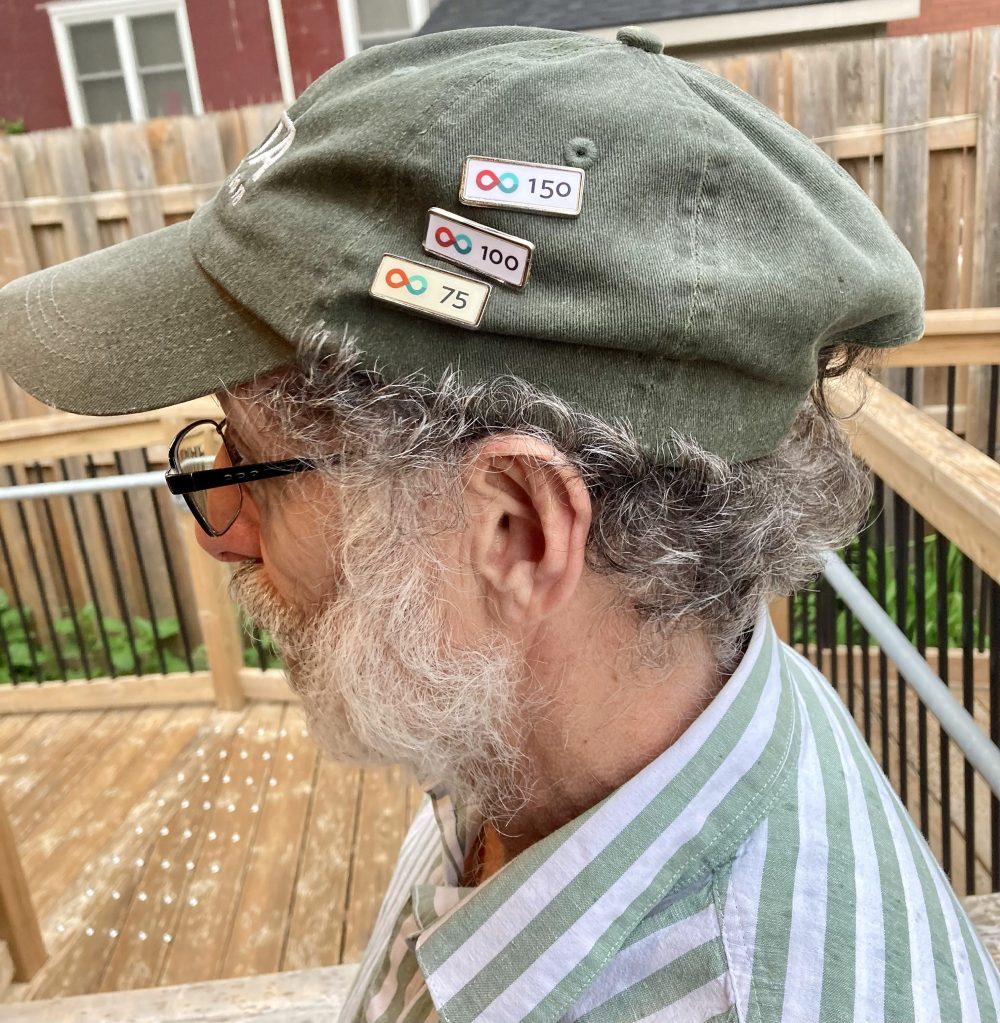
My pal Alec is one of those 27,000, inching close to joining the 2,200 in the 250+ club. He gives blood and more-frequent plasma donations.
Men can donate whole blood every 56 days and women every 84 days, or twelve weeks. So even the keenest female donor is limited to four whole blood donations a year. Those in-the-hundreds donors likely donate plasma, as Alex does, which can be done as frequently as weekly. In that case, blood is pumped out of you, the plasma removed, and the rest of the blood (red blood cells, white blood cells and platelets) is then returned to you.
Stratford, where I live, doesn’t have a permanent blood donation location. Every few weeks, a medical team and portable clinic set-up ships out from London, Ontario, about an hour’s drive away. They usually set up at the Stratford Rotary Complex, in a giant white, florescent-lit cube of a room used for trade shows and other events. This same team goes to other rented locations around southern Ontario.
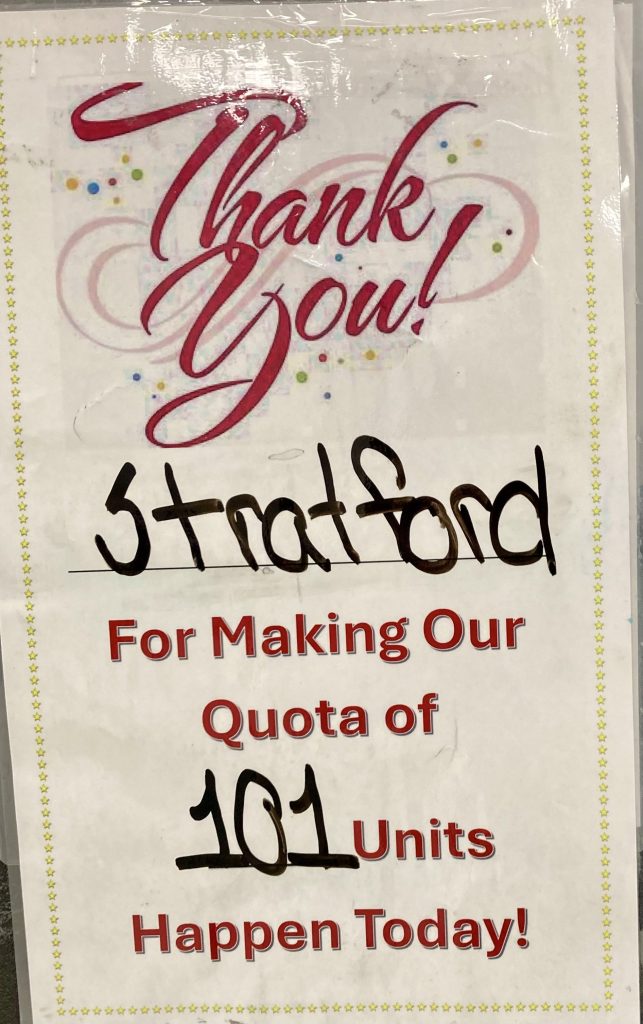
I made a first appointment at the Rotary Complex clinic in fall 2023. You get a bottle of water and something salty to eat when you arrive. You go through a lengthy questionnaire that assesses your health and ability to donate. The questions make you realize your life is rather dull, when you keeping saying “no” to queries about about multiple sexual partners, recreational drug consumption, your travel history and whether or not you’ve handled monkeys, recently.
Then it’s off to a private interview, complete with a little jabbing blood prick of your finger to test for your hemoglobin and ferritin (iron) levels. The staff person cross checks everything, prepares several vials and rubbery collection bags with identifying stickers, and then you wait for a donation chair.
You get thanked, frequently, at a blood donor clinic. I expect this is not because clinic workers are preternaturally polite souls: it’s baked into the culture that people who show up deserve gratitude and everyone who meets you during the donation process thanks you.
I still can’t watch the process of getting a needle stuck in my arm. I wait for a donation chair set up for right-arm donation as I’m left handed and it bothers me a tiny, tiny bit less, to have a needle in my right arm. I do the clutch-and-release muscle exercises to speed along the blood flow. And at the end, there’s Cheetos.
Cheetos have to be among the worst-for-you snack foods in the world, which is precisely why the only time I ever eat them is after a blood donation. You’re supposed to replenish your fluid and salt levels and eat/drink while waiting at the clinic for 15 minutes after donating, in case you have some wooziness or other reaction. There’s a table filled with bottles of juice, water, and packages of sweet and savory snacks for your replenishment delight.
When I’m in the donation chair, my face must radiate some sad mix of grimness and fright. I frequently have nurses bending near my face, asking quietly, “are you OK?” “I don’t like needles,” I whisper back. “You’re doing great,” they’ll often say. “Just a few minutes more.”
So why do I put myself through this? The Cheetos help. But more importantly, I want to be the kind of person who volunteers to help others. There is no medical reason why I can’t donate blood. Getting around my mental roadblock took a lot of years, but I’m happy to have a tiny “10” pin from Canadian Blood Services that proves, at least 10 times in the last three years, my better self got hold of the wheel.

Hope to run into you at a future donation clinic Kelley!
LikeLiked by 1 person