After securing a contractor, and a place to live during renovations, my next priority: a year-long digital membership in Consumer Reports for a whopping $39.
Consumer Reports (CR), formerly Consumers Union, is described as “an American nonprofit consumer organization dedicated to independent product testing, investigative journalism, consumer-oriented research, public education, and consumer advocacy.”
On social media, the organization and its attendant magazine gets promoted as “a non-profit with no ads. CR is accountable only to you. Unbiased and science-based, our ratings are second to none.”
Some people are year-in year-out Consumer Reports folks: they enjoy articles about consumer products and heaven knows likely every year there’s something you might want to look up: the organization tests and ranks everything from appliances to wood stains, with hundreds of categories in between. In the lead-up to a renovation, you can save a lot of money, and aggravation, turning to their detailed reports to guide your choices.
For how do we pick a product about which we know little? Often we turn to recommendations from friends, or comments on sales sites. Those things are all well and good but the precise, thorough examination items go through in Consumer Reports world are trusted by millions, including me.
Example: buying a dishwasher.
For design reasons, we decided we wanted a model where you could replace the front metal door with cabinetry, what’s called a “panel-ready” model. I checked out panel-ready dishwashers and up popped one — a Bosch model — at a decent price with an 84 ranking, scoring well on low energy use, low noise and great cleaning. It was a relief to walk to our local appliance store, say “where’s this one?”, take a look at it and announce, “we’ll take it.”
Consumer Reports also teaches you that, while it is true quality can cost more money, often there’s a lot of fancy out there that hides the fact a snazzy object isn’t very good at what it’s supposed to do.
Example: stoves, which CR always calls “ranges.”
Within “ranges”, CR hives off those considered “pro style”: having the look and feel of a professional, restaurant-quality appliance. “Pro-style ranges make a statement,” begins the website text on this section. “But despite their high price, they aren’t the best ranges we’ve tested.”
Well, that’s an understatement once you dig into the rankings. Top-line “pro-style” Miele, a German manufacturer of high-end domestic appliances, with a price well north of $6,000 US? Ranking: 38. The LG gas range we’re getting at less than one-third that price? Ranking: 87 with “no performance flaws.”
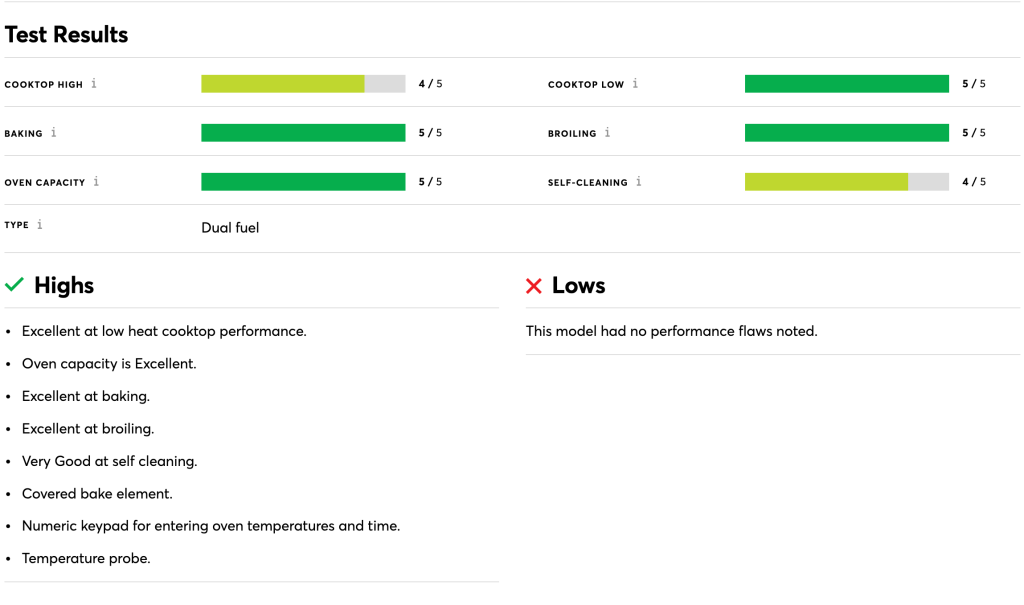
So what exactly do they test? It depends on the product involved. In the case of ranges, each model is put through the following tests:
- Cooktop high: How quickly the highest-powered cooktop burner or element heated a large pot of water to a near boil.
- Cooktop low: How well the lowest-powered element or burner kept a low temperature as for melting chocolate and how well the highest element or burner, set on low, held tomato sauce below a boil.
- Baking: Baking tests to measure even browning of cakes and cookies baked on two oven racks.
- Broiling: Test high heating performance by searing a tray of burgers
- Oven capacity: Gauge of usable oven space.
- Self-cleaning: Test removal of a mixture of baked-on eggs, cheese, pie filling, and other ingredients using its self-cleaning cycle.
There are few worthwhile shortcuts when you’re on Renovation Road. But I can vouch: when you are noodling over new items to buy for your new design, take the shortcut marked Consumer Reports.

I wish I’d read this before we started our renovations! What a smart idea. I spent a lot of time researching what to buy, this definitely would have save us time.
LikeLike
I don’t see Farrow and Ball even listed as a paint that Consumer Reports rated.
LikeLike