Three years ago when we needed to furnish our Stratford house for rental, I went bargain hunting at an online estate auction.
I had my long list of items we needed and, when the auction house posted the online catalogue, I went through and tagged items of interest. I focused on an auction in Stratford, figuring it was easier (and cheaper) to store items there until we took possession of our Stratford house in a couple months’ time. The plan: furnish the rental with placeholder items that would do until we could bring our real furniture from Toronto.
My secret weapon was my dear friend John. I was doing this online searching while in Toronto and he went to the in-person auction preview in Stratford to pass judgment on my choices.
There were two dining tables, each with six chairs. One was advertised as oak and the shape was pleasing, although it looked a bit yellow-y in the photos. The second was advertised as teak and rosewood, a rectangular table with large tiles inset down the middle. The pictures didn’t show the details well. I wrote to John, “that could be nice, or that could be awful. Let me know.”
Mid-century-modern teak was not John’s favourite: he preferred more ornate and plush stylings. Nevertheless, he reported back that the teak set was in good shape apart from worn chair upholstery and that I should take a pass on the oak, where the yellowish finish looked even more urine-like in person.
Someone whose items were being sold at this auction really liked teak: There was a teak bedroom set and teak end tables, also with ceramic inserts. I bid on all of them and got the whole lot for around $600.
In recent years, teak has become “so hot right now”, to quote Mugatu from Zoolander. Post-auction, I did some internet sleuthing and was shocked to find out just how much this stuff sells for when it’s been reconditioned and in peak shape.
When we moved these items into our little house, their simple lines suited the house’s simplicity. I marvelled at the practicality of having tile in the centre of the dining table. The bedroom set furnished the guest room: a queen bed frame with built-in nightstands; a long nine-drawer bureau; a teak-framed mirror; and two more small storage units, one on casters and with open shelving. That guest bedroom has mirrored closet doors so we moved the teak mirror to the main floor along with the shelf unit on wheels.
At some point, we realized that the teak dining room table was a better fit, long term, than my beloved cherry wood table, which had been my grandparents and which I had been using since my first dining room in a London, Ontario apartment. About a year ago, I started looking at online auctions again to see if I could find a companion teak sideboard for our table. I found one, and prepared my bid.
This time, there was more competition and the price drove higher, but I got it.
Now that we were planning to keep the teak — and its aesthetic would drive many of our renovation decisions — it was time to learn about its care and feeding.
Fortunately, my friend Susanna is a teak whisperer. Her mother was born in Denmark and Susanna grew up in a house in Canada filled with Danish teak furnishings. She promised to visit and bring her teak care kit with her.
First thing: cloths cut from soft old T shirts. Second, a bowl of soapy water (Susanna uses Sunlight dish soap). Next, a bottle of isopropyl alcohol. Fourth, a pack of touch-up markers and crayons in varying wood shades. Finally, teak oil.
First, you clean the piece of furniture, taking care to wring out your cloth after dipping it in the soapy water. Let the teak dry. Next, gently wipe the wood, following the grain, with a cloth dampened with the alcohol. After that dries, next comes a fresh cloth with light coating of oil, which you also gently apply with the grain. That needs to sit for a few hours before you give it a dry cloth wipe. Sometimes a “thirsty” surface will want another oil treatment. You can use the markers or crayons to touch up any nicks. Long term, you do this conditioning about once a year.
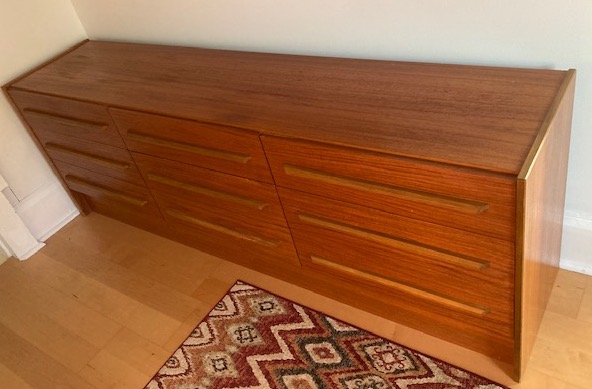
I’ve done the bedroom furniture because it’s staying in place during the renovation and the dresser, in particular, came up stunningly well: it had many scratches and scuffs and they’re now all gone. We’ll do the dining room furniture once it’s moved back in, after the renovations.
We chose cherry, the closest wood tone to teak available in butcher block, for our new kitchen island and we’re adding other mid-century-modern-inspired touches to complement the farmhouse-style vibe of things such as our Shaker panel cupboards. This 1950s’ teak looks great next to teal / turquoise: the previous owners had used that colour on two accent walls in the house and we’re carrying shades of teal forward into the new design.
In the end, we’ll have contributions from the best of 19th, 20th and 21st centuries in our little home. And, for me, teak is the top of 20th-century design.

Hi Kelly
I’m enjoying your reno report, spending someone else’s money vicariously is strange satisfying.
<
div>Have you discovered the sh
LikeLike
Love, love, love your sideboard. And with the teal it’s all very Mad Men. Still a little shocked you are not keeping your cherished dining table.
LikeLike
You’ll get to see it in all its glory (and in its new location in the room that used to be the kitchen) in the summer!
LikeLike
Your teak care instructions have been shared with my niece who just acquired a beautiful teak console yesterday! Perfect timing- as usual Ms T!
LikeLike