If you crave certainty in your life, never buy an old house.
While I grew up in a bungalow built by my father in the 1950s and later a two-storey suburb-style home built in the 1970s, as an adult I’ve gravitated to older homes, which in Ontario means houses built in the 19th century. They are never perfect. They have charming quirks. You may also feel the winter wind blowing through electrical sockets and you will become adept at using shims to keep furniture level.
When we bought the Stratford house, we connected with the Stratford-Perth branch of the Architectural Conservancy of Ontario (ACO) which, for a modest fee, will research your property and create a plaque showing its date of build and name of the first owner. Our place was built sometime between 1871 and 1877 (there are conflicting records), with the first recorded owner being tinsmith Abel Coulton.
In the mid 19th century, William McCulloch was a wealthy man whose 100-acre estate encompassed much of what is now Queen’s Park and the grounds for the Stratford Festival Theatre. In 1840, he built a large home on the estate that he named The Grange. The entrance to that residence came off Stratford’s main thoroughfare, Ontario Street: the historical records note that large ornamental gates faced Ontario Street and opened to a tree-lined roadway. Thirty-some years later, someone built a little house on this lane about halfway between the main street and The Grange. This private roadway later became a public street and more houses got built. It became Trow Avenue, named after James Trow, a businessman, politician and the Grange estate’s second owner.
Thanks to sleuthing by the ACO’s diligent volunteers, we knew that Abel Coulton lived briefly at this little lane house with his wife Henrietta Jamieson and their only son, George, born in 1875. This family sold the house to Abel’s brother and lived there as tenants for a couple years before moving to Cleveland, Ohio. Going through the family history, we were charmed to discover that George spent the rest of his life in Cleveland and had three children of his own, who share names with my partner’s uncle, his daughter and my great-nephew.
We haven’t done further research (yet) to discover the chain of ownership throughout a century and a half. We do know the existing house is built in three parts, from the 1870s, the 1920s and a 21st-century addition by the owners before us. You can see three distinct sections in the very low and rough basement.
The first job in this renovation was to tear down the ceiling over what will be the new kitchen. That’s at one end of a large rectangular space where the other end will be the living room. (Yes, it was going to remain the dining room, but things change. Keep reading.) The plan had been to build a framing wall to divide the two spaces so we’d only need to pull down part of the ceiling and level that portion.
And then, the crew and their crowbars got to work.
Surprise No. 1. There were three ceilings up there!
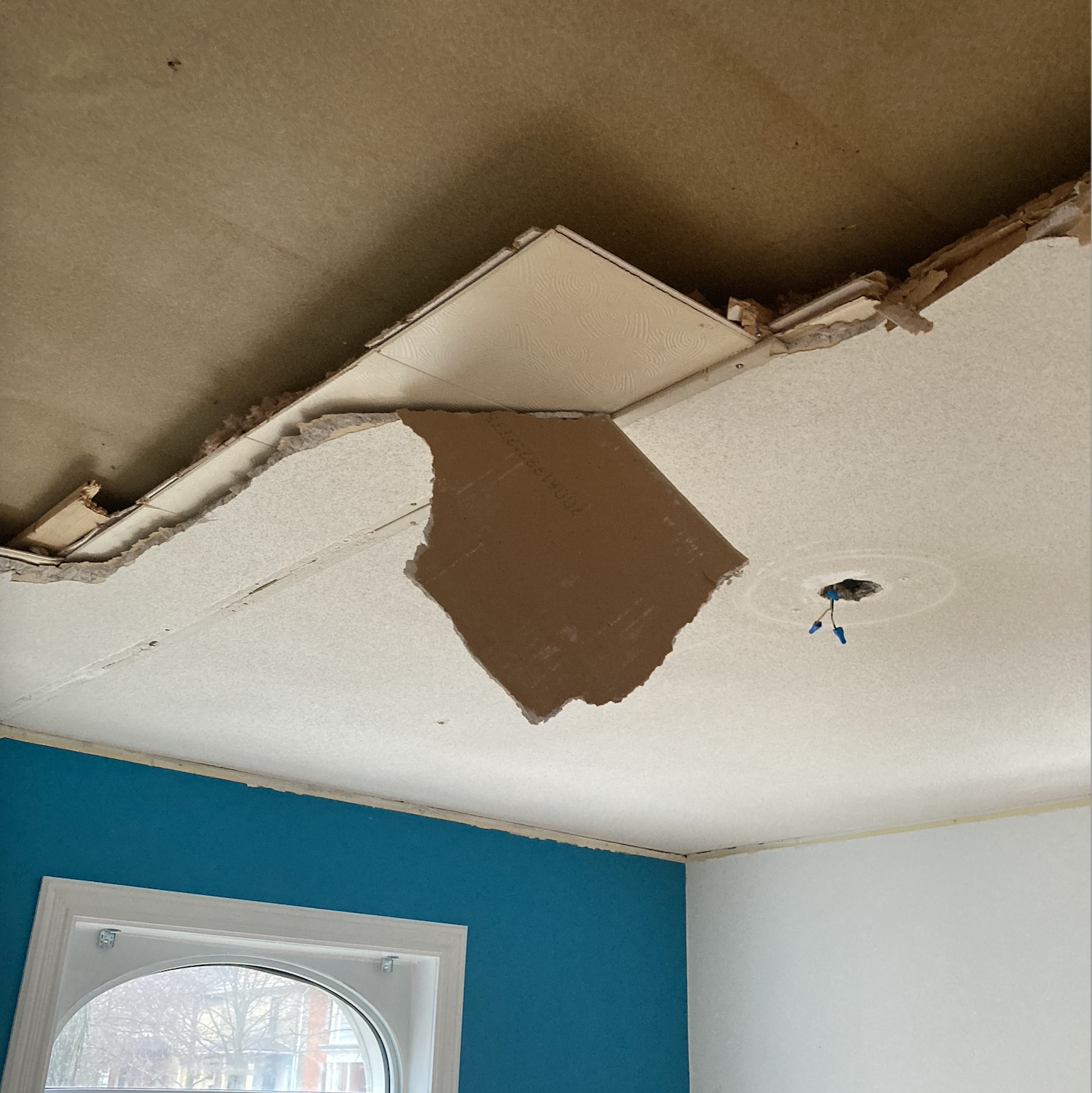
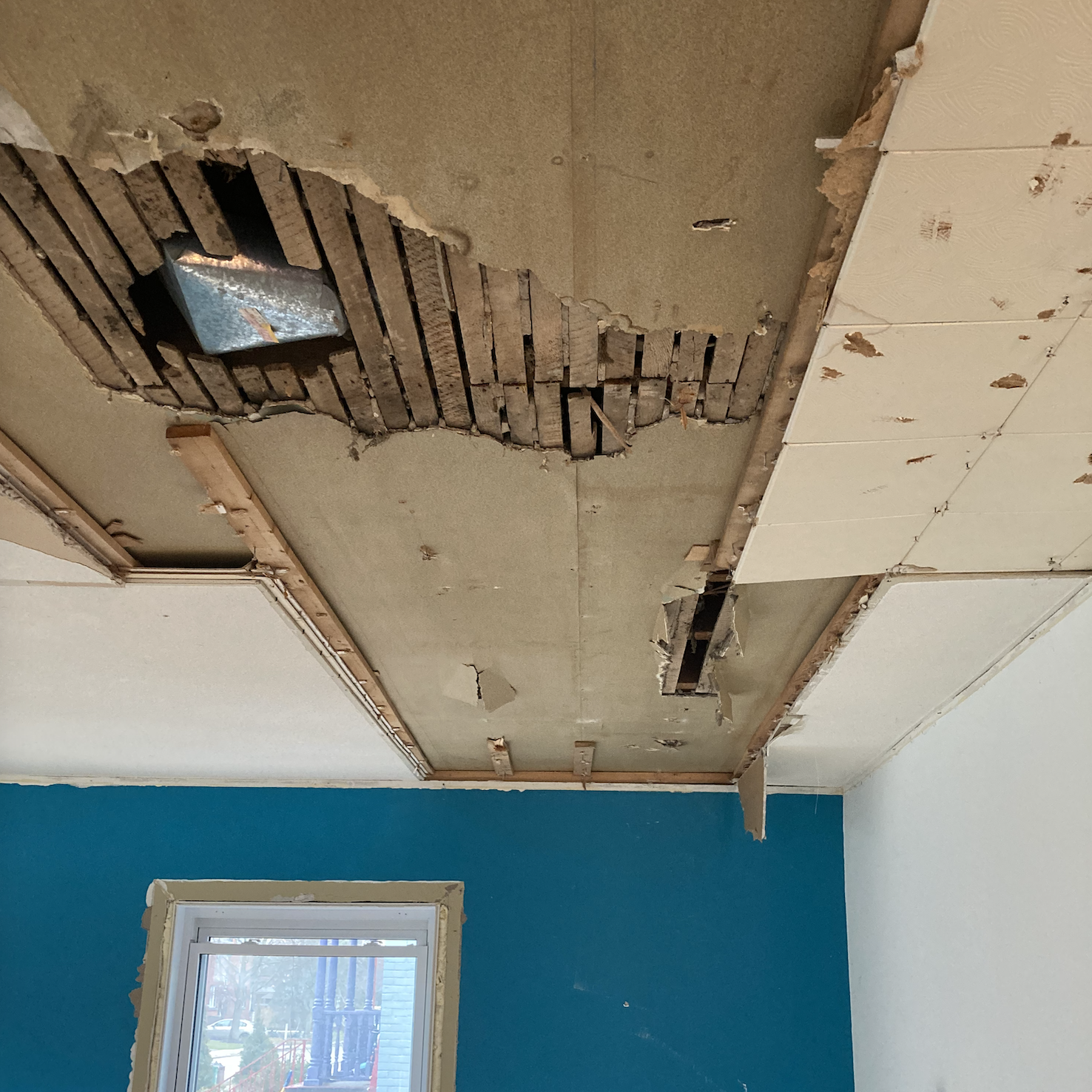
Beneath the original beams was a ceiling. Below that, likely installed in the 1950s, was a tile ceiling. And below that, someone had adding wood strapping and then screwed drywall to that for ceiling no. 3 which was (of course) covered in loathsome popcorn stipple.
So on renovation Day 1, we did a plan shift and gave the go-ahead to tear down the entire ceiling. “While we’re at it, we’ll take out all this drywall too so we can make sure the new kitchen walls are level,” said Jerry, the contractor. I’ve done this enough to know that while it looks a fright, it can actually be quicker and cheaper to work from a clean slate, rather than cutting existing drywall, fishing through all needed wiring and trying to level things up.
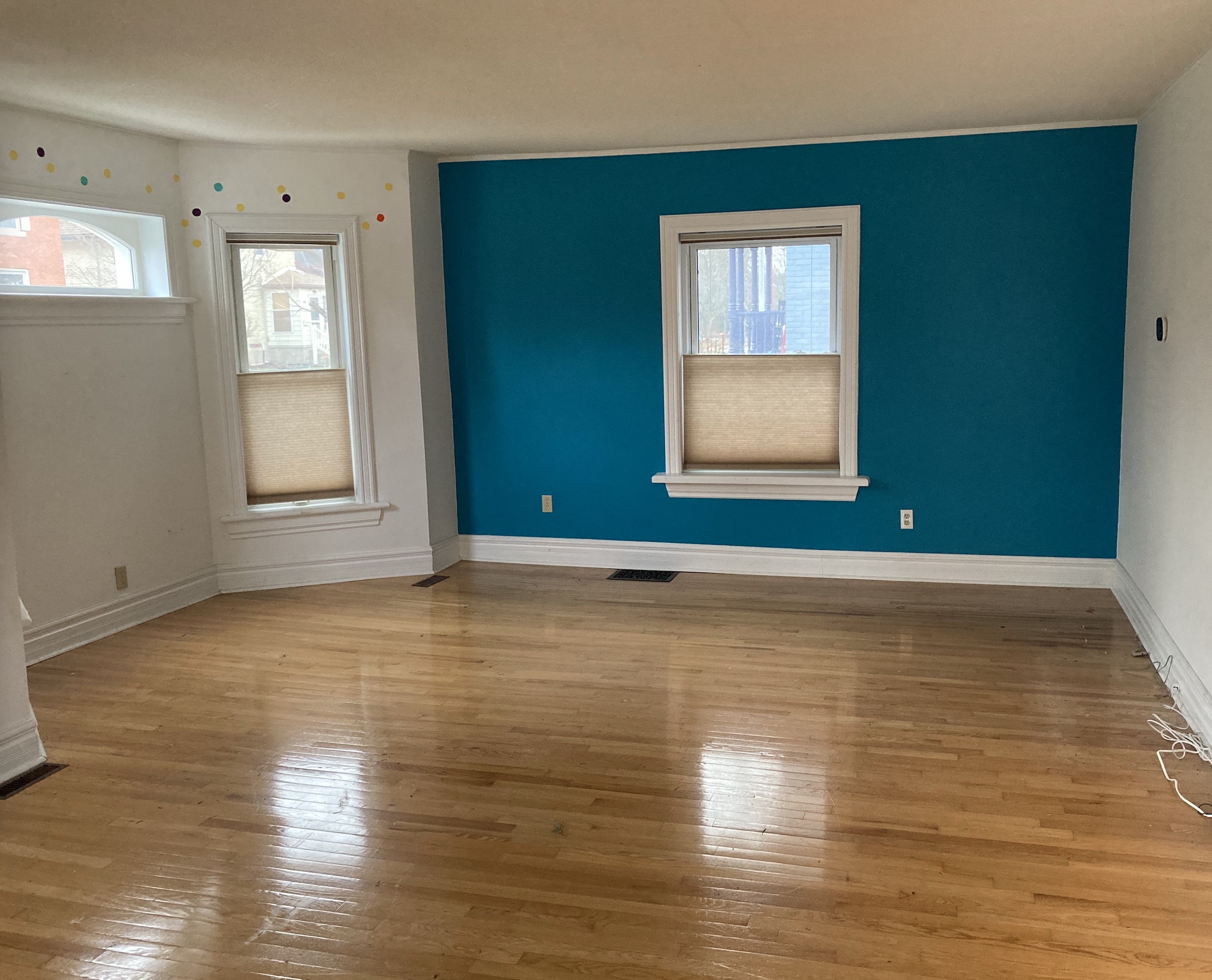
By the end of day 3, the former living room and dining room, seen empty in photo one prior to renovation starting, looked like photo two: (You can click on and slide the arrow button to see the full version of each picture.)
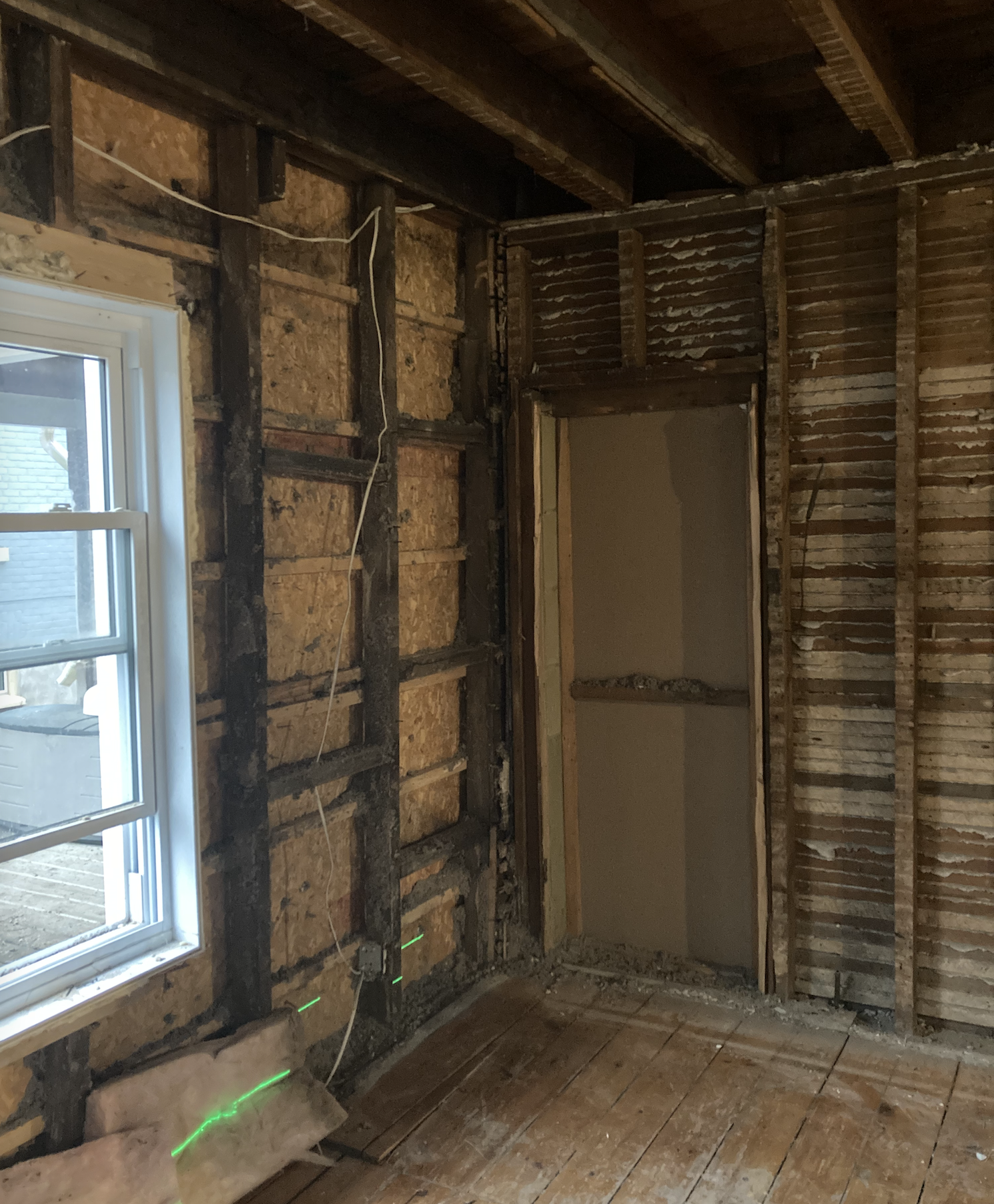
We also discovered there were a few layers of walls along the east side of the room, which means we might gain a bit of space, up and across. In the original house, there was a shallow cabinet built into the wall, painted a light green, which was later covered over by newer walls. And while the house’s electrical wiring had long been updated, scads of dead knob-and-tube clung to the rafters.
Relatively modern narrow-strip oak flooring in this space turned out to be quite thin, depth-wise. It rested on plywood sheeting, which covered original wood floors. There used to be partial walls dividing this long rectangular room that would have been the entire main floor in the 1870s — you can see marks on the floor boards — and there are various other mysterious wood patches. The floors have wider boards for part of the room but then there’s a different, narrower wood used at the room’s west end. For a moment the thought flickered, should we try to fix and use this old flooring? But after a closer look, we realized it’s in pretty rough shape.
So far, we haven’t discovered any messages, in a bottle or otherwise. But, there’s more demolition to come. Maybe we’ll still find a mark from wee George Coulton, who played as a boy on these very floor boards.

Keep posting this brings back many memories of our restoration at the farm. Tearing back to the beginning, we believed was the ver best idea. Many people don’t want to do this, as you can see! There were some pretty nasty renos..you are doing it right, in my humble opinion.
Onward!
LikeLike
I think “Loathsome Popcorn Stipple” would make a great band name.
LikeLike
I’m going to enjoy hearing your stories.
LikeLike
The most expensive phrase in the English language: “While we’re at it.”
Enjoying your Blogs Kelley!
LikeLike