Even for Canadians like me, whose idea of sport is a brisk round of improv theatre competition, hockey is in the blood. Saturday nights growing up, we watched Hockey Night in Canada as a family. My father was a good player in his day and refereed for many years. I grew up rooting for the Elmira Sugar Kings team in the Junior B league who, in those horribly homophobic days, were routinely greeted by hisses of “Sugar Queeeeeeens” from the arena stands.
If I had grown up in Stratford, no doubt I would have followed the Stratford Cullitons, as they were known then, (also Junior B), and would have been inside the William Allman Arena before my recent first-time visit.
We walk by the arena all the time. For visitors, it’s the building along the river between the Tom Patterson and Festival theatres. But for locals, it’s an icon of Stratford, of sport, and of memory.
This facility opened in 1924 as the Classic City Arena: it was purchased by the the city in 1941 and renamed the Stratford Arena. The current name came into effect in 1996 to honour long-time arena manager William (Bill) Allman.
The arena has undergone many renovations over the past 100 years but has been open and operational for every hockey season since 1924, making it one of the world’s oldest continuously operating arenas. Many similar arenas in Canada have been replaced by more-modern energy-efficient structures, including in Elmira, my hometown. Says Gary Wray, a former Culliton player who later worked at the arena: “It’s just an energy guzzler. There’s almost no economic reason to keep the building going: It’s the history and the heritage.”
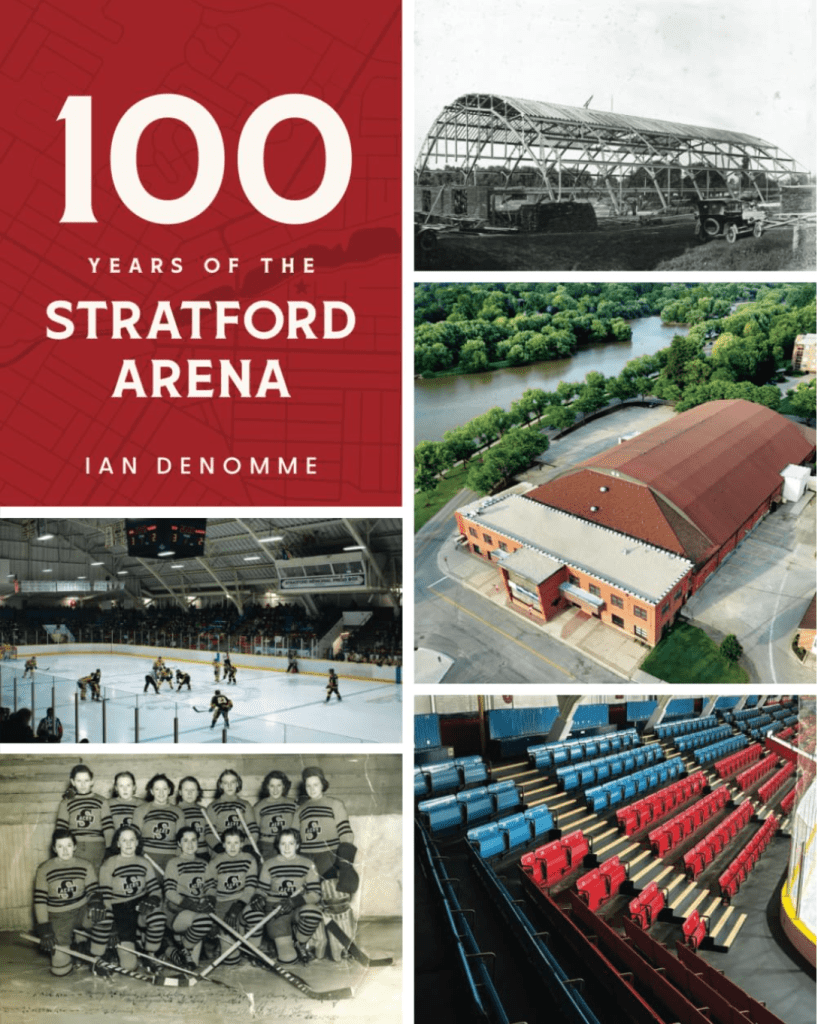
In honour of the arena’s centenary in 2024, sportswriter Ian Denomme, who grew up in Stratford, wrote a book: 100 Years of the Stratford Arena. If you are interested in much more detail than I can cover in a blog post, I highly recommend picking up this book. Says Denomme: “Entering the William Allman Memorial Arena is like going back in time. The arena has maintained its original look, feel and charm over the course of repeated renovations over the last 100 years. … There are very few community arenas left with that same bowl seating. Even fewer have player benches on opposite sides of the ice.”
The iconic red and blue wood fold-up seats – theoretically each can seat two, although at the game we attended, many people spread out one person per seat – were installed in 1960. The arched roof, with its curved steel trusses and wood finish, inspires sporty poetry. In Denomme’s book, people refer to the arena as “a cathedral like no other”, and “a beautiful old building” with its “barrel roof that goes up forever”.
We decided to go to a Friday night game at the arena between the Sugar Kings and the Stratford Warriors – the original name of the Junior B team, and its name once again, after the years 1975 to 2016 when the Culliton brothers, who owned an electrical, plumbing and HVAC company in Stratford, sponsored the team and had name rights.
Going into the game, it looked good for the Sugar Kings as their wins and statistics to date had outpaced the Warriors. But after nearly 14 minutes of power skating from Elmira – I haven’t watched hockey in person in decades, and was amazed at the players’ speed – the Warriors turned it around and scored a goal. They got two more goals, outshooting and out-powering Elmira for the rest of the evening, winning 3-1.
The arena seats more than I thought: 2,799, about 1,000 seats more than the huge Festival Theatre down the road. There’s also generous standing room behind the last row of seats all around the arena. Even though the seats that night were only one-third full (if that), I counted between 70 and 80 people who chose to stand at the back, at either end behind the net.
The crowd was all ages: Families; packs of little kids who ran off during the game to the concession stand in the lobby to get popcorn or pop, or to the bathroom; seniors; cool teens in groups or in pairs; clusters of guys, with a few wearing team memorabilia, some Warriors, others Cullitons. I saw only one person I know, and he was volunteering at the concession booth, a fundraiser for the Kinsmen Club.
The guy behind me at one point yelled at the ref, who was talking to a Sugar King player: “Speak slowly! He’s from El-MYYYYYY-raaaaaah”. No Queeeeeeen taunting, anyore.
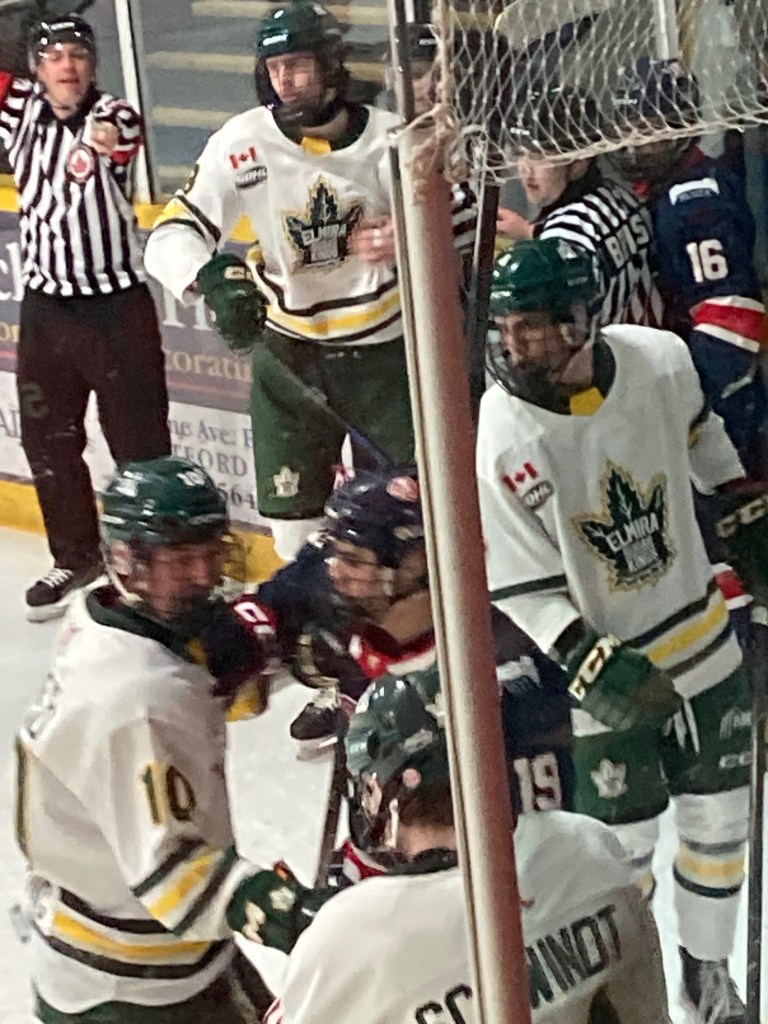
As the Elmira team kept getting outplayed, tempers started flaring and a check turned into a shove, and then formed a snarly pack of testosterone. There were a couple minor penalties given out, and the crowd barely noticed, although Stratford did score another goal with one player up.
If I was able to skate still – I haven’t skated since grade school – perhaps I’d enjoy the other main use of the Allman more. It’s been the home the Stratford Skating Club since the late 1930s. The biggest star out of that program was Don McPherson who, at age 18 in 1963, won the world figure skating championships. Both figure skaters and hockey players learn skating techniques through the club.
And while most recreational skating now happens at one of Stratford’s other three public indoor rinks, recreational skating used to happen regularly on Tuesday and Saturday nights at the then Stratford Arena. In fact, my husband’s uncle, Stewart Knechtel, met his wife of 65 years, Barbara, at a recreational skate there. Their story is recorded in Denomme’s book, which devotes a section to “The People” of the arena.
Still, sitting in the stands at a Junior B hockey game, it does feel like you are, in the moment, at the centre of Stratford. The rink boards are lined with advertisements from local businesses, including one for Teahen Construction. (We are likely related, but we have yet to figure who is our common ancestor.) The announcer promoted Gilly’s Pub on Downie Street as being “across from the Avon Theatre” – Avon being pronounced the hometown way with a short “a” like “avocado”; not a long “a” like “bake”.
And I did have a deliciously smug moment at the end of the third period. The clock showed under three minutes left. “We can leave soon,” I assured my husband, whose enthusiasm for this adventure was minimal, especially when he understood I intended to stay for the whole game. He sighed, “You said we have to stay until the end, and there’s another period left.” I know there are only three periods in hockey but sometimes, silence serves you well, especially when the final buzzer blared a couple minutes later, the Warriors skated to centre ice with sticks a-banging in victory, and I got to hear those rare, precious words coming from a man. “Oh. I guess you were right.”
Photos: Kelley Teahen
