One of the more endearing characteristics of old houses are their weird windows.
The house we’re fixing in up in Stratford, Ontario, has a few that we’re incorporating into our new design.
In the oldest part of the house, there are two half-moon windows set up higher on the wall. Their placement lets in light while providing privacy as that north wall faces a street with bursts of pedestrian traffic in our city’s theatre season: this road is a common route between the Festival Theatre and the downtown shops and restaurants. When we bought the house, these windows were single paned and in winter would sweat condensation (and leak heat) unless covered with plastic seal you adhered to the frame with the heat of a hair dryer.
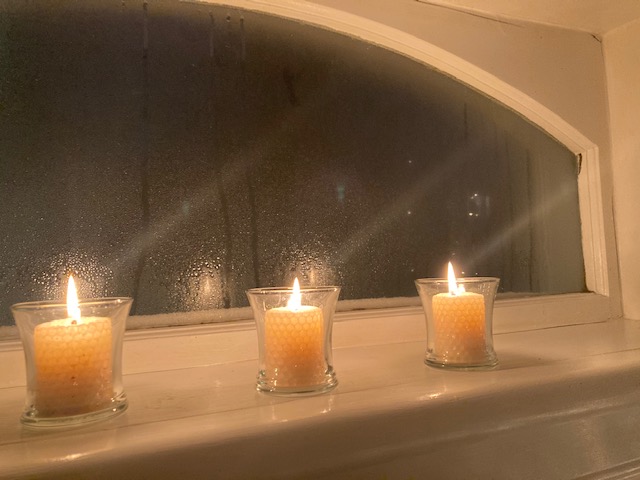
In our first year of owning the house, we got new thermopane glass installed in the half-moons: a tricky job of templates and custom cutting and re-installation. In the new design, one of these windows will be set above a gas fireplace in the living room and the other highlights what will be a cozy seating nook in the new kitchen.
The hall entrance has a porthole window (shown in this post’s feature photo) in a beautiful cobalt blue glass that gives a wonderful rich glow to the space when the afternoon sun hits it. I’ve only seen one other like it in our little city, with clear glass, and assume that whoever built our house built that one, too. Its colour has shaped the tile and colour choices for the hall, as well as guided the artwork we’ll use in the space.
The new dining room, in the 1920s’ portion of the house, has a west-facing window with a churchy-looking panel of stained glass diamonds in yellow, colbalt blue, a pale green and a dull purply-pink. I’ve seen pictures of the house prior to the previous owners’ renovation that added a wing at back, and a second identical window was in place where they later reinstated the original front door location. The coloured glass is marred with what looks like rust that washing didn’t remove. I didn’t know if it was fixable or not, but an expert tells me it is.
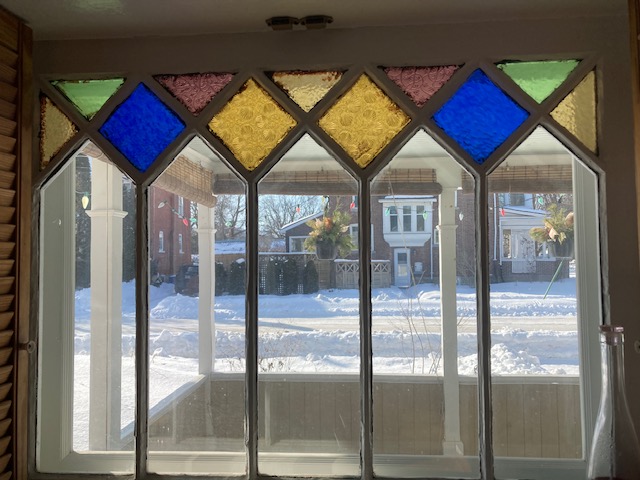
“Your window has wood mullions that divide the opening into separate panes,” wrote Roger Chapman of Sunrise Stained Glass in nearby London, Ontario, in answer to my plea for help. “The rusty brown patches are probably putty or paint that has got on the glass and hardened. The best way to clean this off would be with paint remover and a scraper or wire brush. This can be done in place if you are careful.” We added a custom-built storm window over this 1920s’ stained one to better insulate this space, and I’ll tackle the careful clean in the spring, once the storm comes down.
Our final weird window is actually a new one installed in the 2000 addition’s second floor. It’s less weird in its construction — a pretty standard vertical rectangular window with a crank opening — than in its function. The window screen is constructed to pop in-and-out easily because, when the screen is out, you then have access to a clothesline that’s strung from this second-storey window to a poll at the corner of the side yard. It’s genius: You can hang clothes out to dry without having them take up space in the yard. One of our tenants mentioned it was cool, but also unnerving: “I feel a bit of vertigo leaning out there,” she told me.
Having weird windows means you need to be creative with any kind of window coverings, or decide you don’t need coverings at all. But weird, when it comes to windows, adds character and charm, so long as you deal with the leaky bits to keep your heating costs down.

You definitely will have an unique home. Sooo interesting.
LikeLike