Canada’s Centennial celebrations, 50 years ago in 1967, gave birth to many things, including one of the best book titles in some time: The Year Canadians Lost their Minds and Found their Country: The Centennial of 1967 by Mark Hawthorn.
Projects that started as one-time Centennial celebrations (such as Toronto’s Caribana) found footing and became annual events; many of the Centennial parks, halls, and other public spaces built to commemorate the country’s 100th anniversary serve their communities to this day.
But, as Hawthorn puts it in an interview with Canadian Geographic about his 2017 book, the lasting legacy is one of attitude. “Up until then, Canada had lived in the shadow of Britain and the U.S. – and sometimes we still struggle with that – but I think Canadians realized at the end of ’67 that we have something special and unique here.”

Designer Stuart Ash is one of the key people who visualized that new confidence. The co-founder of Gottschalk & Ash, itself celebrating 50 years as part of the merged design and communications company Entro | G+A, believes the Centennial celebrations “launched a new atmosphere in Canada: open and interested, multicultural and confident.”
His reflections are found in a fascinating book Cultivating a Design Legacy, about the emergence of modern design in Canada. As a former client of Entro | G+A, I was lucky enough to attend the book launch in 2017 in Toronto and meet the man responsible for the look-and-feel of Canada’s Centennial.
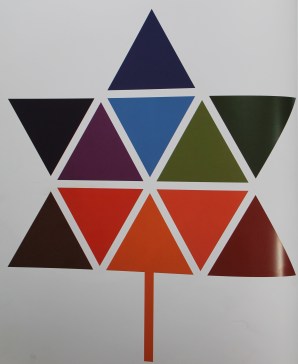 The government of the day in 1966 had run an open-ended design competition: something that is loathsome to designers, who consider this “spec” (speculation) work, where people produce finished products for no pay merely for the chance of possibly winning a commission. The competition produced poor results, so they then turned to Cooper & Beatty design firm to create a logo. Stuart Ash, an apprentice there, created the winning design: a maple leaf constructed from 11 equilateral triangles representing the country’s geography at the time of 10 provinces and Canada North. He went on to create the design manual for all things Centennial and the reputation he built through all that helped him launch his own design firm with Swiss-born partner Fritz Gottschalk.
Jay Cross, writing the foreword to Cultivating a Design Legacy, postulates that with post-war economic boom in both Switzerland and Canada, there was capacity and hunger for new design thinking in these countries. Gottschalk’s “graphic approach” (i.e., Swiss) and Ash’s “design exuberance” (i.e. Canada) merged to produce work that was “always simple, always fresh, always elegant.”
There had already been this kind of simple, fresh, and elegant design in Canada before, notably the still-used-to-this-day CN logo created by Toronto designer Allan Fleming in 1960. But, the book argues, the modern spirit unleashed in Centennial year, and most notably at the showcase Expo ’67, “brought graphic design into the world of branding, marketing, he new idiom of wayfinding, and architecture.”
The International and Universal Exposition, known as Expo ’67, ran in Montreal from April 27 to Oct. 29 in 1967. While there were centennial celebrations across the country, it was the grand event, the collective whoop-de-doo of Canada coming of age.

In 2013, my brother and I cleaned out our parents home after my father’s death: we found a cache of Centennial flags neatly preserved in a packing tube (featured in the main photo) that possibly had been on display in my father’s store in 1967, and an Expo apron my brother, who went to Expo ’67 on a school trip as a boy, brought home for mom.
The buildings of Expo were Jetsons-esque in their futuristic domes and angles, and inspired more modernity in real-life architecture and environmental design.
Another young designer – this time of buildings – also made a huge mark at Expo. Habitat 67 was originally conceived as part of Moshe Safdie’s McGill University thesis; while built as a pavilion at the exposition, its design and use after the fair was as residential space: Safdie created dense urban housing (12 stories at its highest) using prefabricated concrete forms, while still integrating some of the benefits of standalone homes: gardens, fresh, air, privacy, and multiple levels.
And, as I’ve already written about in Ontario Place’s Wild Ride, the beyond-the-film-box thinking that created Expo ’67’s then-startling projections and displays led to the Canadian invention of IMAX, a new form of filmmaking.
Several Canadian media outlets did stories in April 2017 to mark the 50th anniversary of Expo ’67’s opening. One by the Canadian Press interviewed someone who had been a nine-year-old boy living in Montreal at that time, whose family took advantage of an Expo Passport that allowed visitors to return to the site multiple times and get their “passport” stamped at each country’s pavilion. “I didn’t know about India or Africa or the space exhibit at the U.S. pavilion,” Rick Rake recalled. “I’d never seen anything like that before, so it was like entering a fantasy world.”
That kind of global awareness helped Canadian designers (and their Canadian clients) to embrace the “international style” of design prevalent in the 1960s: modernist, minimalist, and functional.
Should Canada have tried for another whoop-de-do Expo in 2017 to mark our 150th? Perhaps this time, the celebration is not so much a coming-out debutante party, where the youngster gets pumped up to launch into a Grand World Tour. At 150, Canadians have more awareness of what we need to improve, as well as what we need to celebrate.
Expo ’67 was “the right time, the right moment,” said Rake, now living on Canada’s west coast. “It’s one of those parties you can’t really ever recreate.”
Main photo: Kelley Teahen with Centennial flags from her parents’ home, at Toronto’s City Hall, a modernist design by Viljo Revell completed in 1965. Photo by Kelly Sather.

One Comment Add yours