I love people-watching in hotel lobbies and, across Canada, we have two railways to thank for the best grand rooms and views.
Both Canadian Pacific Railway and Canadian National Railway built hotels as rail service expanded across Canada in the late 19th and early 20th centuries. Some were built in city hubs, such as Ottawa’s Château Laurier, or Toronto’s Royal York. Others were built as destination hotels in scenic locations such as Banff, Lake Louise, and Jasper.
Many have a similar look and feel; one article on “Canada’s grand railway hotels” calls it château style, which “became known as a distinctly Canadian form of architecture. The use of towers and turrets, and other Scottish baronial and French château architectural elements, became a signature style of Canada’s majestic hotels.”
Until diving into some research on the railway hotels, I had no idea how many of them there once were; some have been divested to other ownership (such as Nova Scotia’s Digby Pines) while others have been torn down or redeveloped for other purposes.
Canadian Pacific grand hotels still in operation under the Fairmont brand are:
- Banff Springs Hotel, Banff, Alberta, opened in 1888;
- Château Lake Louise, Lake Louise, Alberta, opened in 1890;
- The Empress Hotel, Victoria, British Columbia, opened in 1908;
- Château Frontenac, Quebec City, Quebec, opened 1893;
- Palliser Hotel, Calgary, Alberta, opened in 1914;
- Royal York Hotel, Toronto, Ontario, opened 1929;
- Château Montebello, Montebello, Quebec, opened 1930.
In 1988, several hotels founded by the Canadian National Railway become part of the Fairmont group: of those, I’ve visited the Jasper Park Hotel in Jasper, Alberta; the Hotel Macdonald in Edmonton, Alberta; the Château Laurier in Ottawa; and the Queen Elizabeth in Montreal.
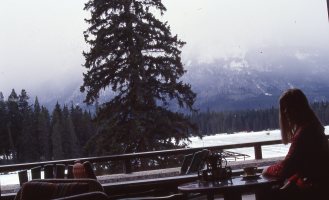
The Jasper Park Lodge, built in 1922 on the shores of Lac Beauvert and a four-hour drive west of Edmonton, has more of a ski-lodge feel, with huge windows, stone walls, and wood everywhere. The central lobby faces a wall of windows overlooking lake and mountains; the old central lodge is now augmented by a sprawling range of more-modern accommodations.
I love going to the Château Laurier when on a visit to Ottawa; I even stayed there a couple times while on business trips and it’s a combination of startling and romantic to see the Canadian Parliament Buildings framed by your bedroom window. Best of all, though, is having tea or a drink at its chandelier-lit Zoé’s Lounge. I remember being there one sunny Friday afternoon after a day of gallery-going on a vacation when staying elsewhere in Ottawa, and the next table was filled with men and women in impeccable dark-blue suits, speaking French. Several ordered a drink I’d never seen before: Kir Royal. I can report, having placed a copy-cat order, that it is indeed the perfect drink (champagne and blackcurrant liqueur) for the elegant Laurier space.
Of all the rail hotels, however, the one I know best is the Royal York. When opened in 1929, it was the tallest building not only in Toronto, but anywhere in the British Commonwealth. It was built across from Union Station (and connected to it via an under-street tunnel) on the site of a previous hotel demolished to make room for what Fairmont now somewhat floridly describes as a building ” replete with mechanical genius and opulence never before seen in Toronto.”

While I’ve never stayed there overnight, the Library Bar or the Royal York’s spacious two-storey lobby were my go-to spots to pass some time or meet a business contact when I would be in Toronto on business and catching a train back to southern Ontario.

Even now that I live in Toronto, I still enjoy meeting people there, seeing the elaborate decorations in holiday seasons, and having a respite from all the bustle of the downtown, especially after a day of meetings or travel.
Because it is a hotel, with attentive staff at every turn, it’s also a comfortable place to be on your own: I’ve spent many a pleasant hour in a comfy wing chair or on a couch in the Library Bar, reading a newspaper or book and sipping a glass of wine or cup of tea on my own, without harassment or interruption, waiting for a train departure or another appointment.
There’s also a tiny bar few know about tucked into the mezzanine level of the lobby, York Station, open only from noon to 7 p.m.; It’s dotted with train memorabilia and, when cajoled, the bartender puts on a striped engineer’s cap and presses a button that launches a model train around a track suspended from the ceiling.
The Royal York, like all its Canadian hotel cousins, also hosts many weddings, banquets, and corporate events. But what sets these grand dames apart from their more-modern competitors, besides a century of history, are those lobbies: simultaneously elegant and comfortable, where all of us feel just a bit royal, passing through.
Main photo: John Lederman
